
A map of complexity’s foundations
Unraveling complexity: building knowledge, one paper at a time
If you find value in #ComplexityThoughts, consider helping it grow by subscribing and sharing it with friends, colleagues or on social media. Your support makes a real difference.
→ Don’t miss the podcast version of this post: click on “Spotify/Apple Podcast” above!
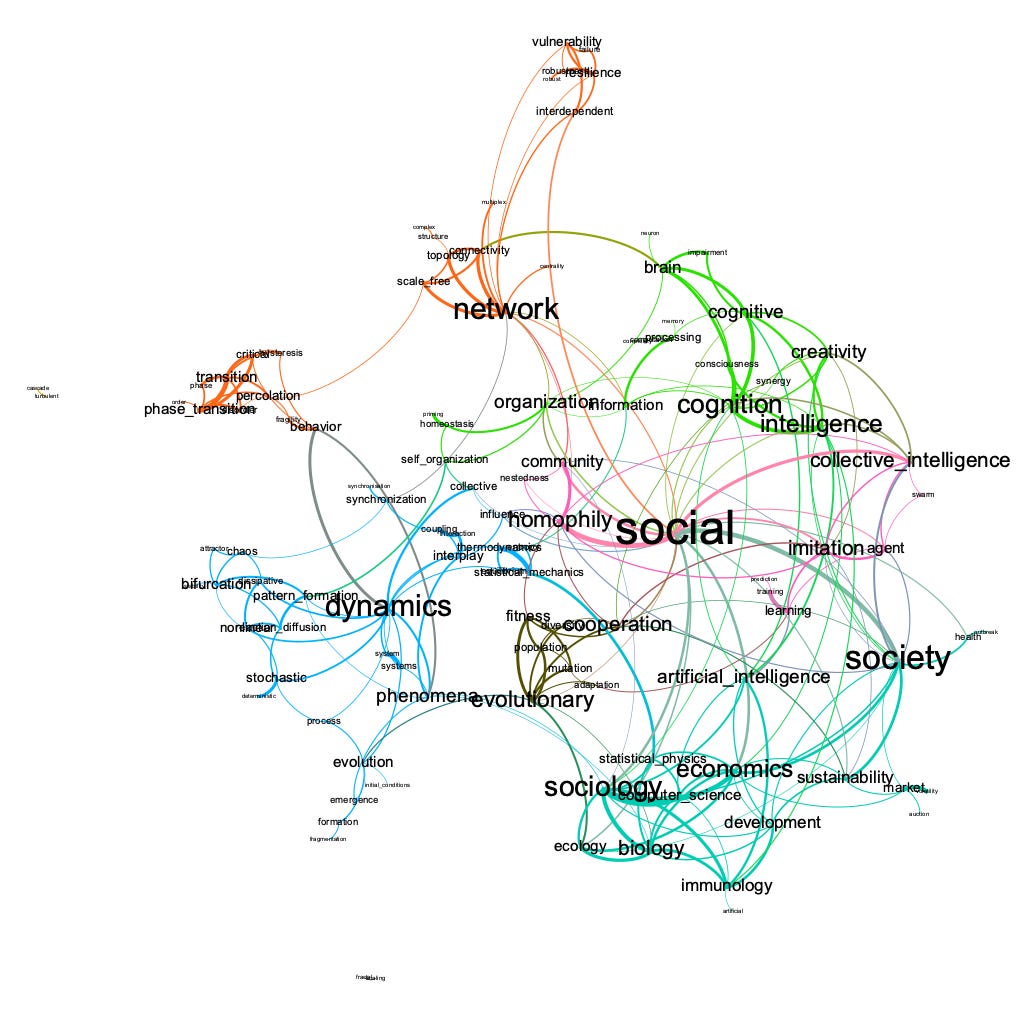
Complex systems and network science have grown through many intellectual lineages: statistical physics, nonlinear dynamics, information theory, biology, ecology, computation, social science, epidemiology, neuroscience and several others. This plurality is part of what makes the field interesting, although it also makes a simple question surprisingly hard to answer: what are the works that really shaped how we think about complexity?
In 2018 I made a related attempt at the level of concepts rather than papers. I started from a manually curated vocabulary of terms associated with complexity, queried thousands of arXiv papers around those concepts, trained word-embedding models on the retrieved abstracts and used similarity networks and clustering to obtain a first map of conceptual neighborhoods. The figure above gives a sense of my exercise, although I would read it with caution: the pipeline was semi-supervised, sensitive to the initial choice of terms, limited by the arXiv corpus and inevitably shaped by the modeling decisions I made at the time. It was useful as an exploratory prototype, not as a definitive reconstruction of the field1.
I am now launching MINERVA2, a community-driven initiative to build a structured map of foundational contributions in complex systems and network science. The focus is paper-centered, because the goal is to reconstruct ideas, methods, models, and conceptual bridges rather than reputations or academic genealogies.
This is easy to misunderstand as an attempt to define a canon, which is not the spirit of this initiative. I am interested in something more useful: a navigable view of the intellectual substrate of the field, including the papers everyone remembers, the papers that entered from neighboring disciplines, as well as the papers that are often used implicitly without being described as “complex systems” or “network science”.
Bibliometric and algorithmic approaches can reveal a great deal about topical structure, citations and explicit communities, yet foundational ideas often travel in less visible ways. They may come from older vocabularies, adjacent traditions, technical methods or conceptual imports that later became naturalized inside the field. However, I think that recovering this structure requires distributed judgment from the community.
This is why broad participation matters: senior researchers bring historical perspective on how certain ideas entered and transformed the field; early-career researchers often see connections across areas that older disciplinary narratives may miss; researchers from different subfields will naturally emphasize different foundations, and this diversity is precisely the point.
The current step is simple. If you work in complex systems, network science or a neighboring area, you can contribute a small set of papers you consider foundational; DOI references are enough. Widely recognized papers are useful, and so are overlooked contributions that deserve to be visible in the map.
The submitted references will be aggregated, deduplicated and analyzed across subfields and types of contribution: theoretical frameworks, methods, applications, interdisciplinary bridges and foundational imports from adjacent areas. Contributors will receive early access to the results, which will later be shared publicly together with the methodology.
→ The survey takes less than 10 minutes: click here.
MINERVA can only work if the community contributes its own memory of the field. If you think complex systems and network science would benefit from a clearer map of their foundations, please contribute and share the initiative with colleagues, students and researchers across related domains.
Thank you!
P.S. We have already collected several hundred recommended papers. A scientific committee, involving leading complexity scientists from different countries and research traditions, will help evaluate the procedure used to construct the final corpus. Stay tuned, and get involved.
→ Please, remind that if you find value in #ComplexityThoughts, you might consider helping it grow by subscribing, or by sharing it with friends, colleagues or on social media. See also this post to learn more about this space.
My friend and colleague Hiroki Sayama made a similar attempt in 2025, with a much broader and less biased corpus.
MINERVA is named after the Roman goddess of wisdom, knowledge, arts, and strategy. The name is used here to evoke the idea of a collective, structured effort to make visible the intellectual foundations of complex systems and network science.