
Complexity Thoughts: Issue #84
Unraveling complexity: building knowledge, one paper at a time
If you find value in #ComplexityThoughts, consider helping it grow by subscribing and sharing it with friends, colleagues or on social media. Your support makes a real difference.
→ Don’t miss the podcast version of this post: click on “Spotify/Apple Podcast” above!
Foundations of network science and complex systems
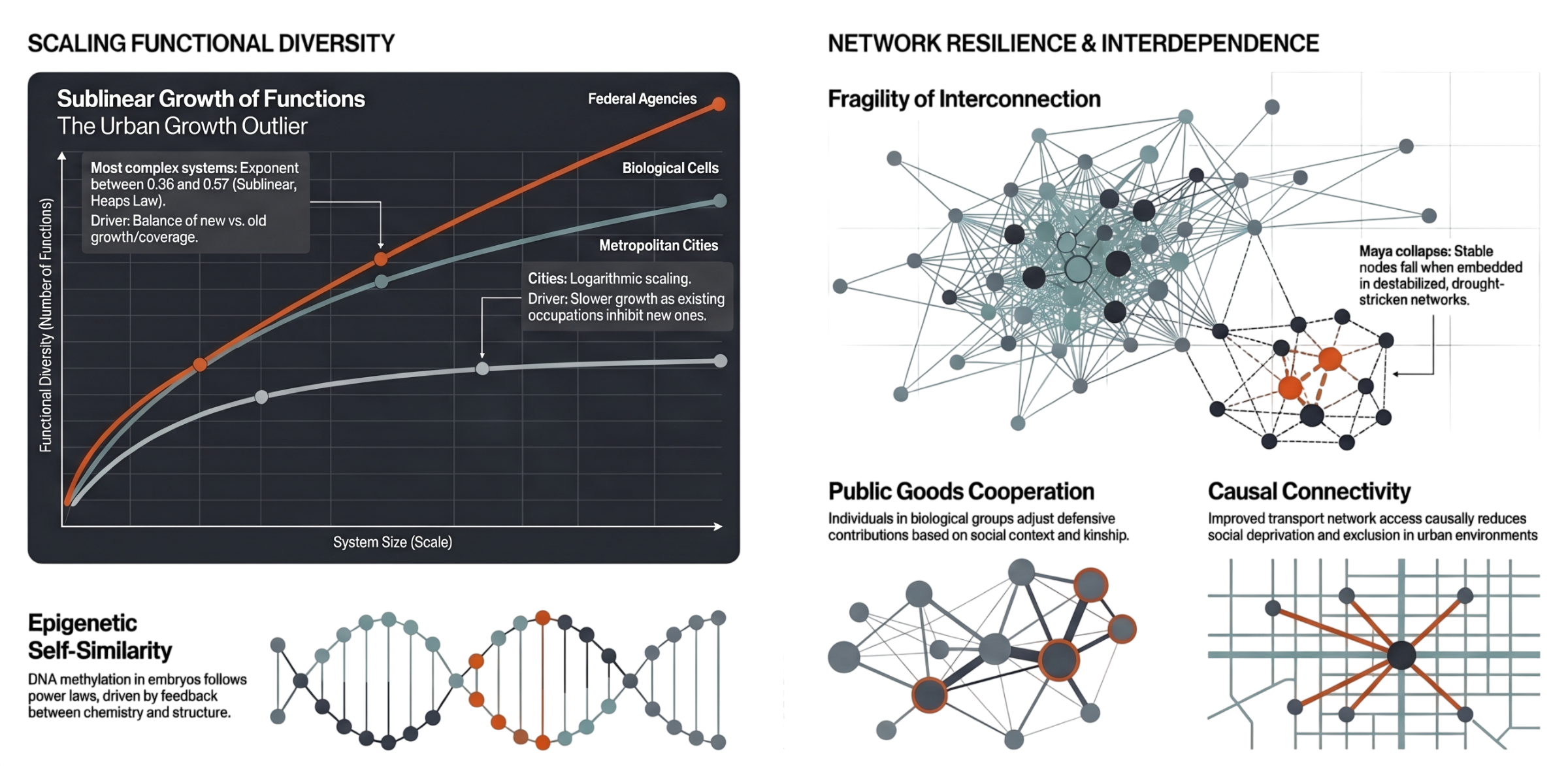
Diversification and specialization are central to complex adaptive systems, yet overarching principles across domains remain elusive. We introduce a general theory that unifies diversity and specialization across disparate systems, including microbes, federal agencies, companies, universities, and cities, characterized by two key parameters. We show from extensive data that function diversity scales with system size as a sublinear power law-resembling Heaps’ law-in all but cities, where it is logarithmic. Our theory explains both behaviors and suggests that function creation depends on system goals and structure: federal agencies tend to ensure functional coverage; cities slow new function growth as old ones expand, and cells occupy an intermediate position. Once functions are introduced, their growth follows a remarkably universal pattern across all systems.
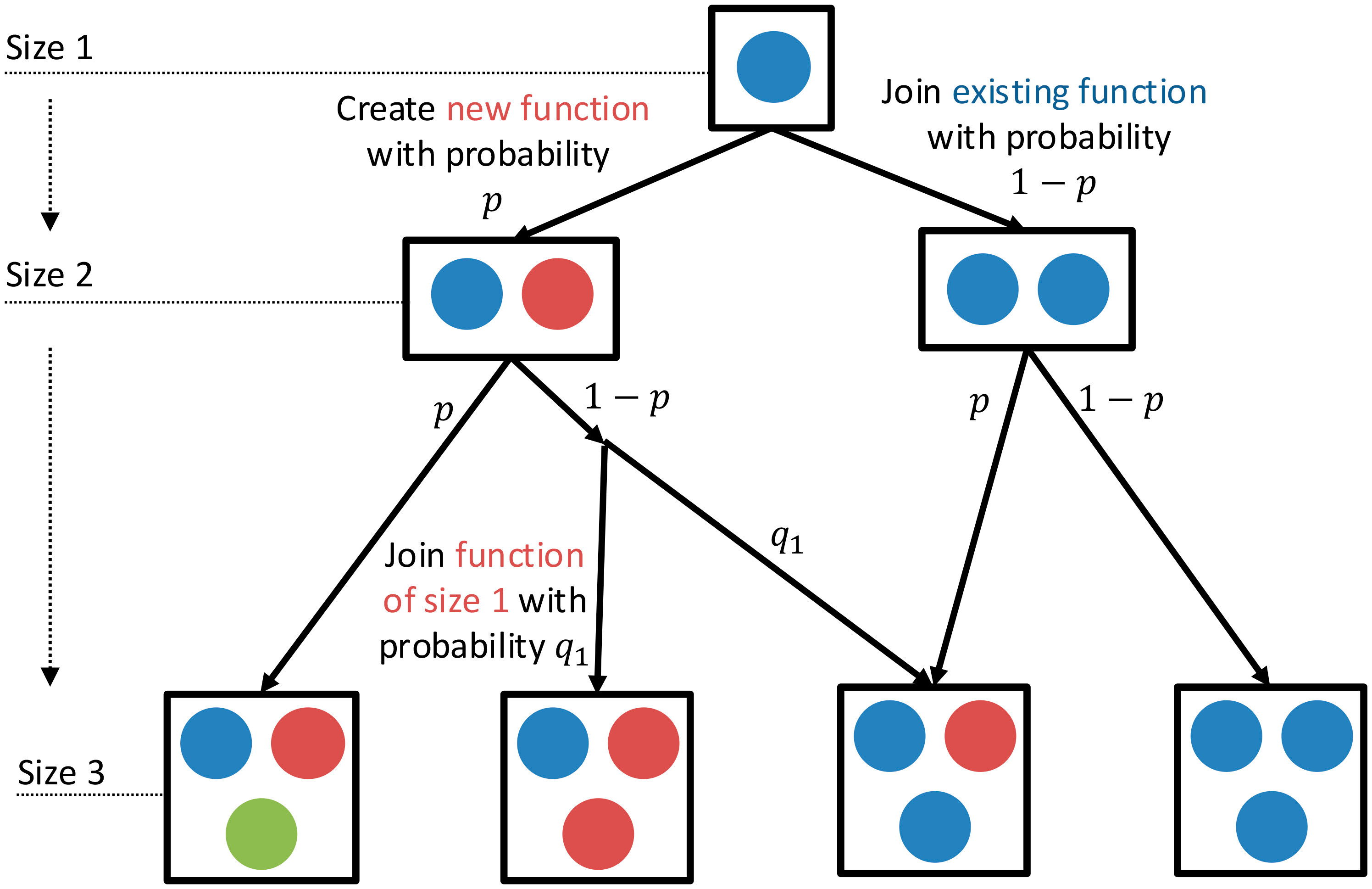
Function diversity, the range of tasks individuals perform, and specialization, the distribution of function abundances, are fundamental to complex adaptive systems. In the absence of overarching principles, these properties have appeared domain-specific. Here, we introduce an empirical framework and a mathematical model for the diversification and specialization of functions across disparate systems, including bacteria, federal agencies, universities, corporations, and cities. We find that the number of functions grows sublinearly with system size, with exponents from 0.35 to 0.57, consistent with Heaps’ law. In contrast, cities exhibit logarithmic scaling. To explain these empirical findings, we generalize the Yule-Simon model by introducing two key parameters: a diversification parameter that characterizes how existing functions inhibit the creation of new ones and a specialization parameter that describes how a function’s attractiveness depends on its abundance. Our model enables cross-system comparisons, from microorganisms to metropolitan areas. The analysis suggests that what drives the creation of new functions depends on the system’s goals and structure: federal agencies tend to ensure comprehensive coverage of necessary functions; cities tend to slow the creation of new occupations as existing ones expand; and cells occupy an intermediate position. Once functions are introduced, their growth follows a remarkably universal pattern across all systems.
While this study is very interesting and attracted my attention because it is data-driven, I agree with authors about one of its main limitation:
Our proposed framework represents an effective process but does not explicitly capture the causal dynamics through which new functions or components emerge
Another limitation is about finding a principled way to define what a function is, that’s why I think that a better way to frame the question is in terms of functionality.
Our research group work on this matter since one decade, and we have the mechanistic framework needed to study how functionality emerges from the interplay between structure and dynamics. A list and an explanation of our works in the context of complex networks, where we have explicitly identified functional diversity with thermodynamic-like quantities can be found here:

Read also this Commentary for a quick context about the above paper: Functional diversity and specialization decoded: Implications for complex particle systems, NeuroAI, and hybrid human–AI ecosystems
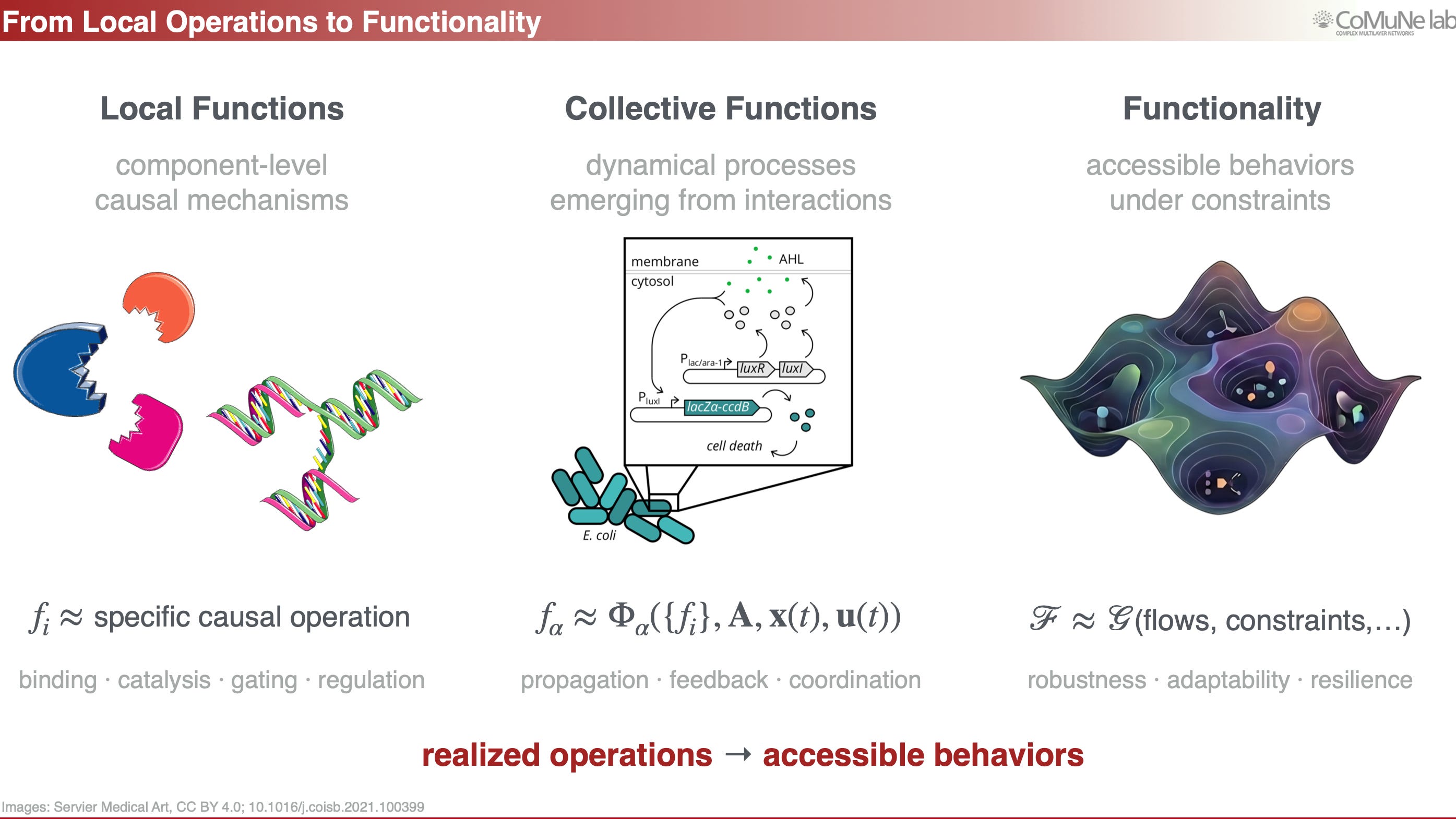
In a recent talk I have given for the U. of Cambridge’s seminar series Making Connections, I have discussed more about this. Specifically, while function can be local or collective (→ a realized operation or capability), functionality is what the system can do under constraints across levels (or scales) and layers (or contexts):
Evolution
Direct and indirect benefits of cooperation in collective defense against predation
Read also this Commentary for a quick context: an insect that cooperates like bacteria
In cooperative breeding birds and mammals, some offspring give up the chance to breed independently and instead help their parents to breed. This type of cooperation involves a division of labor between the “dominant” individuals who do most of the breeding, and the “subordinate” individuals who help rear the offspring of others. Reproductive division of labor is taken to an extreme level in social insects, such as ants and termites, where the subordinate helpers are completely sterile and can be divided into different physical castes, that are specialized to do different jobs.
Individuals in groups can cooperate to achieve shared goals, but they face an evolutionary challenge: if the benefits of cooperation are shared equally, freeloaders receive the same benefits as others while contributing less. Although theoretical solutions to this problem are abundant, we still lack empirical evidence on how those mechanisms function in natural systems. We study this with pine sawfly larvae, which defend collectively against predators. We show that while cooperation increases the survival of individuals and their relatives, they adjust their contributions based on who and how many they are surrounded by, relying more on freeloading in larger and male-biased groups. This results in variation in cooperativeness but prevents freeloaders from taking over.
The evolution and maintenance of public goods cooperation, despite cheating, remains a key interest in social biology. Identifying how ecological factors determine the direct and indirect benefits that maintain cooperation has proven challenging, as these can vary significantly across species and environments. Here, we study this problem using the social pine sawfly Neodiprion sertifer (Hymenoptera) as a model system. During their larval stage, N. sertifer live in groups and collectively secrete a defensive fluid against predators. This behavior comprises a public good as it is costly to exhibit and beneficial to others, and individuals vary in their contribution to group defense. We experimentally manipulated individual contributions to defense to assess how these influence survival under natural insect predation. Our results indicate that defense has a group-level benefit as individuals were more likely to survive in cooperative groups with a higher proportion of defending larvae. Moreover, being able to deploy defensive fluid confers direct survival benefits. Genetic and phenotypic analyses of natural populations further show that kin selection promotes collective defense, as groups of larvae are often composed of full siblings. We also find that the contribution to defense is female-biased and diminishes in larger, more male-biased groups, and to some extent with decreased kinship, indicating that individuals adjust their contributions based on social context. Overall, we find that contribution to the collective defense provides both direct and indirect benefits and that individuals regulate their contributions mainly based on the social environment, resulting in variation within and among natural populations.
The authors present a mutation-and-selection machine: put only the DNA module you want to optimize into a phage-carried plasmid, make the phage replication deliberately error-prone, let bacterial growth select useful variants, then transfer only that DNA module into fresh cells. For a physicist like me, the “clean idea” is a controlled evolutionary dynamics experiment where the “state space” is mostly restricted to a chosen genetic subsystem, while mutations elsewhere in the host are reset each cycle.
They show it works first on a simple selectable gene, then on a multi-gene metabolic pathway. The main finding is methodological, I think: fast directed evolution of large gene modules with reduced contamination from off-target adaptive shortcuts.
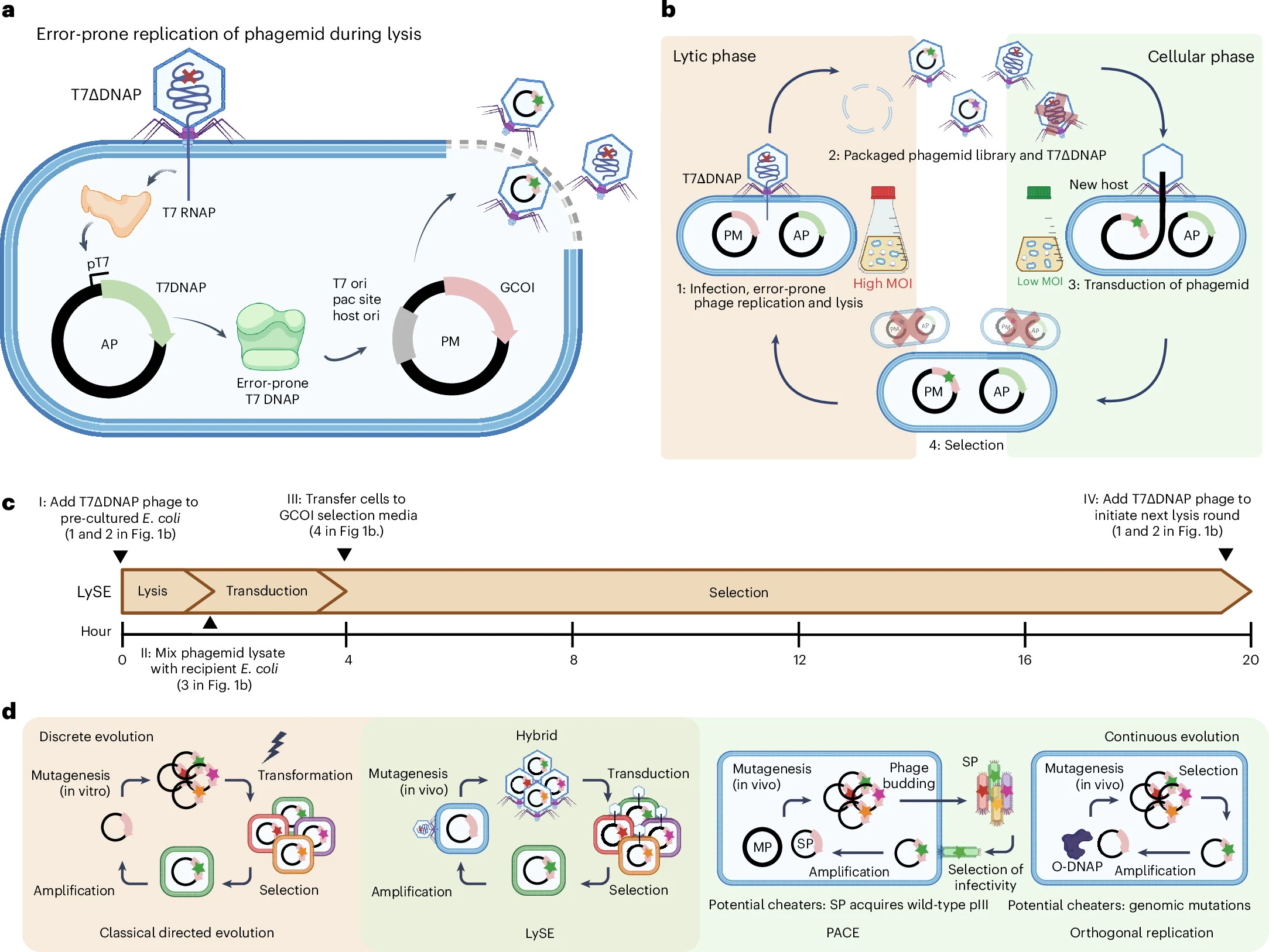
Directed evolution methods face trade-offs between the control of discrete approaches and the throughput of modern continuous systems. Here, we engineered a method called lytic selection and evolution (LySE) for near-continuous evolution of bacterial gene clusters while maintaining discrete checkpoints. We developed a hypermutagenic T7 DNA polymerase variant fused to a dual adenine-cytosine deaminase to install all possible transition mutations at similar frequencies. By relieving pressure from maintaining genome fidelity, we obtained mutation rates of 3.82 × 10⁻⁵ substitutions per base. For biocontainment, the T7 DNA polymerase was encoded on an accessory plasmid, while the target gene cluster was encoded on a T7 DNA polymerase-lacking T7 phagemid. Alternating cycles of lysis and transduction enable selective replication and mutagenesis of target genes, while off-target genomic mutations are discarded. LySE evolved a 25-fold increase in tetA-encoded tigecycline resistance in 5 cycles, and a 50.9% increase in endpoint biomass of a bacterial strain that uses the polyethylene terephthalate monomer, ethylene glycol, as its sole carbon source. Our method balances speed and control for directed bacterial evolution.
Biological Systems
Scaling and self-similarity in the formation of the embryonic epigenome
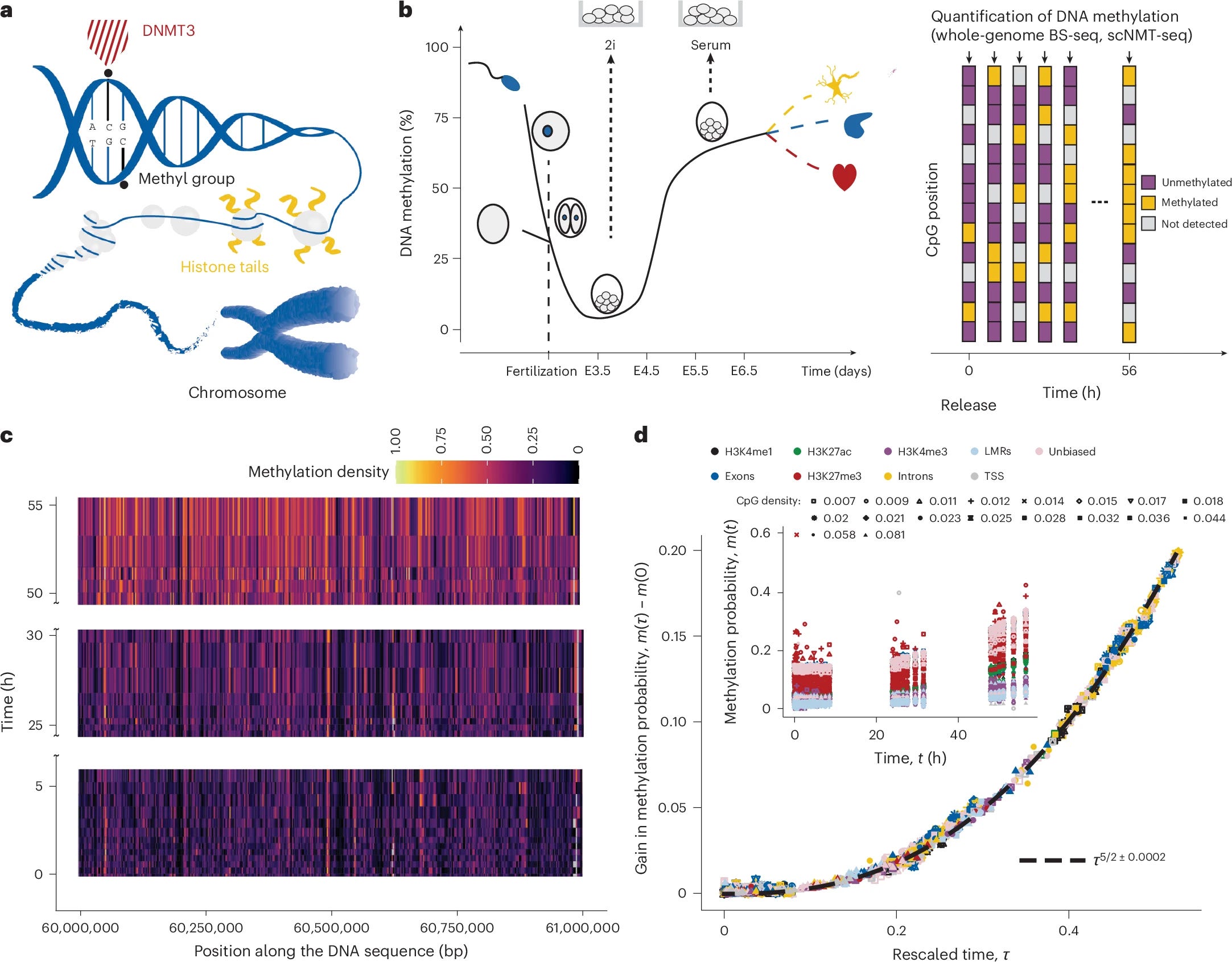
The development of complex tissues relies on the precise assignment of cell identity. At the molecular scale, this process depends on the deposition of epigenetic modifications—such as methylation—that are regulated by complex biochemical networks and occur at specific regions on the DNA and chromatin. Here we show that despite the complexity of epigenetic regulation, dynamical scaling and self-similarity of DNA methylation marks emerge in embryonic development. Drawing on single-cell multi-omics experiments, super-resolution microscopy and statistical physics, we demonstrate that these phenomena originate in dynamical feedback between DNA methylation and the formation of nanoscale dynamic chromatin aggregates. These nanoscale processes lead to genome-wide increase in DNA methylation marks following a power law and self-similar correlation functions. Using this framework, we identify methylation patterns that precede gene expression changes in embryonic symmetry breaking. Our work identifies linear sequencing measurements as a laboratory to study mesoscopic biophysical processes in vivo.
Biogeosciences
Evidence for highly variable land use but a stable climate in the southwest Maya lowlands
Why do stable regions collapse when their environment remains favorable?
This study examines the decline of the Maya city of Itzan, located in an area with relatively reliable rainfall. Despite this advantage, it followed the broader trajectory of collapse affecting drought-stricken regions.
The key insight is systemic: Maya cities functioned as an interconnected network where trade, political alliances and migration created strong dependencies across regions. When drought impacted the central lowlands, it likely initiated cascading disruptions — conflict, economic breakdown and population shifts — that propagated through the system. In this framework, collapse cannot explained by local environmental failure: it emerges from network fragility. Even nodes with stable conditions can fail when embedded in a destabilized system.
If resilience depends on the structure of connections rather than local conditions, how should we assess the stability of today’s globally coupled systems, where economic, technological, and ecological networks are even more tightly linked?
No place fails alone.
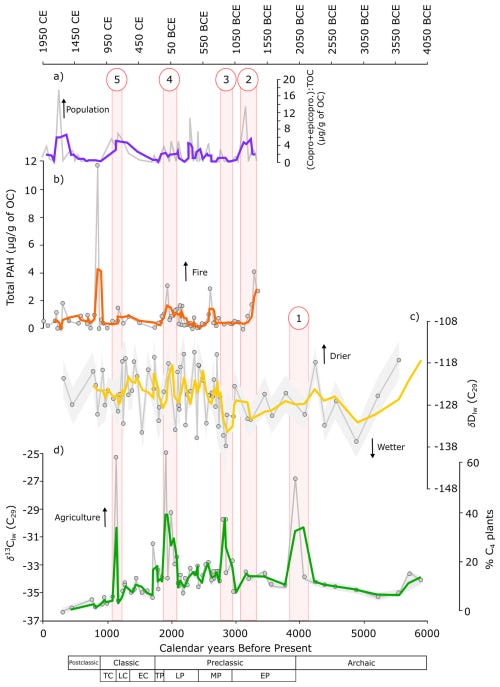
The lowland Maya of Mesoamerica were affected by multiple environmental stresses throughout their history, and many experienced a major demographic and political decline, or collapse, during a period of inferred intense multidecadal drought, approximately 1200- and 1000-years BP. Given regional variation in the timing and character of the collapse (Demarest, 2004; Hodell et al., 2007; Webster et al., 2007; Kennett and Beach, 2014; Douglas et al., 2015), much remains to be discovered about the complex interactions between climate and society in the Maya lowlands. To this end, we combine carbon and hydrogen isotopic analyses of leaf wax n-alkanes with quantification of faecal stanols and polycyclic aromatic hydrocarbons from a lake sediment core from the southwest lowlands to assess whether (1) palaeoecological evidence of land use is related to population change; and (2) whether population and land use are linked to changing precipitation. Our data reveal a transition from generally more intense fire use and C4 plant agriculture during the Preclassic (3500–2000 BP) to dense populations and reduced fire use during the Classic (1600–1000 BP). This is consistent with other evidence for a more urbanised and specialised society in the Classic. We do not find evidence of drought in the hydrogen isotope leaf wax record (δDlw), implying that local drought was not a primary driver of observed variability in land use or population change in the Classic-period southwestern lowlands.
Economic sciences
Uncovering how transport access reduces deprivation: When colocation misleads
There is growing interest in how cities can use transport to reduce disadvantage. A central challenge is measurement: Widely used “accessibility” measures often point to different neighborhoods as underserved, leading to conflicting policy signals. Using a citywide dataset for London, we i) compare common access measures side by side to show how metric choice reshapes the map of accessibility, and ii) contrast simple statistical associations with a causal statistical design that separates access from other neighborhood differences. We find that better access is linked to lower deprivation, yet the choice of measure substantially alters which areas are identified as priorities for intervention. These results can help cities target investments where improved access is most likely to reduce disadvantage.
Since transport access determines who can reach jobs, education, healthcare, and community life, governments increasingly use accessibility improvements to reduce deprivation and tackle social exclusion. Yet whether better access causally reduces disadvantage remains uncertain because observational analyses struggle to separate cause from context, and because accessibility itself can be measured in many, nonequivalent ways. Two challenges follow: i) widely used measures of accessibility, cumulative-opportunity, gravity, and random-utility may yield conflicting maps of accessibility and; ii) estimates from observational data are vulnerable to confounding. This paper conducts a London-wide assessment that a) compares widely used accessibility measures, and b) applies instrumental-variables (IV) estimation with road-safety-based instruments to address confounding and identify the causal effect of accessibility on deprivation. Using neighborhood-scale accessibility and the 2019 Index of Multiple Deprivation (IMD, proxies deprivation, and more broadly, social exclusion), we report two main findings. First, although accessibility rankings are broadly consistent across measures, gravity and cumulative opportunity measures display similar linear behavior, in contrast to the strong nonlinearity of the random-utility measure. The choice of measure affects not only how accessibility is represented, but also the variation retained for empirical analysis. Second, simple correlations suggest that accessibility and deprivation colocate, whereas causal estimates indicate a consistent, beneficial effect: Improvement in accessibility leads to lower deprivation, with magnitudes differing across IMD domains. From a policy perspective, this highlights the importance of grounding transport investment decisions in causal evidence and considering a range of measures to understand how accessibility improvements may help reduce disadvantage.
→ Please, remind that if you find value in #ComplexityThoughts, you might consider helping it grow by subscribing, or by sharing it with friends, colleagues or on social media. See also this post to learn more about this space.